Augmentative & Alternative Communication (AAC) Services
Augmentative & Alternative Communication (AAC) is any form of communication other than speech, that may be used to assist, add on to (augment), or be used as an alternative to speech to ensure communication success. This includes:
No-tech: communicating using gestures, facial expressions, body language, sign-language
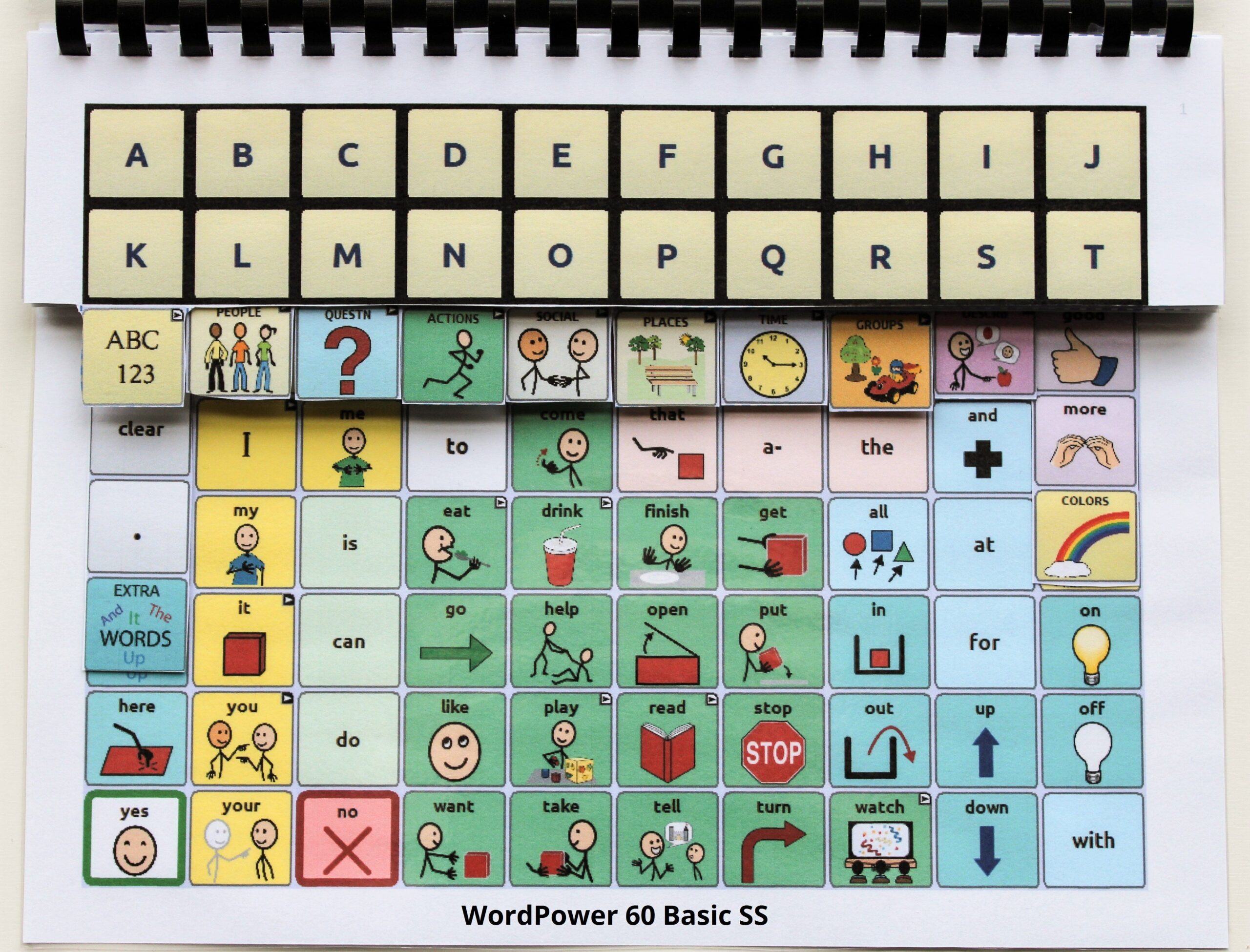
Low-tech: pointing to or looking at pictures, printed communication boards, writing
Mid-tech: single message voice output buttons, recordable button arrays
High-tech: text-to-speech software, symbol-based AAC apps and devices.
Why Use AAC?
All individuals have the right to communicate. (Communication Bill of Rights)
People communicate for a variety of reasons including:
- Comment
- Advocate (for help, autonomy, accommodation, sensory needs, etc.)
- Request
- Greet
- Protest
- Direct others
- Grab attention
- Ask and answer questions
- Express feelings
- Make suggestions
- Share an opinion
- Tell a story
AAC is recommended when speech on its own is not enough for an individual to communicate for all the above reasons and more; whether it be used as a person’s primary form of communication or to assist or supplement speech. AAC tools can also be used to support clarifying messages, repairing communication breakdowns, and act as clearer auditory and written models of intended speech to support expansion of speech and literacy skills.
Who Can Benefit From AAC?
Any individual with speech that is unreliable, or not meeting all of their communication needs may benefit from AAC.
- Pediatrics
- Autistic Individuals (see our Autism Services)
- Developmental disabilities (e.g., Down Syndrome)
- Speech disorders (e.g., Apraxia) (see our Speech Services)
- Adults
- Brain injury as a result of a stroke (Aphasia) or motor-vehicle accident (see our Stroke and Brain Injury Services)
- Degenerative diseases impacting motor control of speech muscles (e.g., ALS, Parkinson’s, Huntington’s Disease, MS) (see our Dysarthria Services)
How We Support AAC
We work with clients to build a communication modality “toolbox” to serve their communication needs, allowing them to say what they want, when they want, to who they want, however they want to and however is most effective for the context.
Through a combination of communication partner coaching, language modelling, aided language stimulation, and incorporating use of AAC tools into therapy sessions, we support adults and children using AAC with a variety of conversation partners, across environments and contexts.
AAC goals may be the main focus of therapy plans, or may be one of multiple goal areas, depending on client needs.
What does an assessment for AAC look like?
When determining which tools to add to a client’s AAC toolbox, we look closely at how a client is already communicating across communication partners, contexts, environments and communication reasons, to ensure support for all areas. We also consider both current needs, future needs, and the ability to grow skills within the tools.
Our goal in assessment is to support families in making choices about what combination of tools will allow for robust, autonomous, self-selected communication.
There are no prerequisite skills for any form of AAC. Individuals can build symbol knowledge, literacy skills, and pragmatic skills while also learning how to navigate and use their AAC tools for a variety of communication functions.
We also consider the following individual client factors in order to ensure we are building skills and providing tools that can be used in any situation the individual may encounter, both now, and as AAC and language skills continue to grow:
- Number of languages spoken
- Current literacy skills and ways to support future literacy skill building
- Understanding of symbolic representations
- Vision and fine motor skills (in collaboration with Occupational Therapy as needed)
- Individual and Caregiver familiarity with technology
- Underlying expressive and receptive language skills
- Communication Environments and Contexts
- Funding access and app cost
High-tech AAC recommendations may include:
- Proloquo2Go (and Proloquo)
- TouchChat DS
- Tobii Dynavox (e.g., TD Snap, TD Motor Plan)
- LAMP – Words for Life
- Avaz
- Weave Chat
- And more!
Therapy for AAC users may include goals that incorporate all of their communication system modalities to target the following areas of AAC Competence (Light & McNaughton, 2014), Blackstone & Wilkins 2009) :
Operational Competency: Ability to navigate device, adjust volume, use individual functions of the high-tech AAC device
Linguistic Competency: Using the AAC system for specific meaning and with grammar that is clear to others
Social Competency: Using the AAC system for social purposes including communication repair
Strategic Competency: Using difference communication modalities from their communication toolbox when other modalities may not be as effective, or for communication repair
Emotional Competency: Using the AAC system for expressing emotions in ways that accurately reflect their internal experiences
Psychosocial Competency: Adapting AAC system functions into everyday life, with confidence, including self-advocacy around AAC system use.
In addition to other client goals identified by the family and Speech-Language Pathologist
Implementing AAC systems is most successful when parents and caregivers are involved in the learning process. In addition to incorporating education into sessions with the client, we also offer virtual or in-person coaching and education sessions directly for the clients’ primary communication partner(s). Learning to support an AAC user can feel like a huge learning curve, but we are here to help you through the process! A coaching session may include learning concepts such as:
- AAC Best Practices
- Naturalistic Language Modeling on AAC (i.e., modeling without expectation for a variety of communicative functions)
- Incorporating multi-modal communication into daily routines and activities
- Motivation, perspective, expectation
- Communicate everywhere
- Honouring all communication modalities as equally valid
- Editing an AAC device for personalization (i.e., adding personal photos of people, interests, hobbies, phrases, etc.)
- Addressing barriers to AAC system implementation
As always, we cater our coaching to fit the individual needs of the client and family and where they feel they would be best supported.
Ontario Autism Program: Your SLP can provide a letter of recommendation for purchase of AAC devices, apps, and associated accessories to be purchased with OAP funding with ongoing support in therapy sessions.
Assistive Devices Program Individual Authorizer: Our ADP Independent Authorizers can support purchase of mid-tech communication devices with the government Assistive Devices Program.
Motor Vehicle Accident Coverage: For Ontario accident benefits, your SLP can submit an OCF-18 Treatment and Assessment Plan requesting funding for AAC devices, apps, and associated accessories that is approved on a case-by-case basis by the insurer.
We’re here to help! Contact us for more information or to schedule an assessment and treatment.