Written by Georgia Languay-Smith, CDA
With contributions from Janelle Vedder, SLP
Traditionally, April has been known as Autism Awareness Month. Here at Lear Communication, we and many others are shifting our lens to make a shift from awareness towards acceptance. However, we can’t have “acceptance” without “awareness”. So, let’s start from the very beginning.
Autism Awareness is knowing that autism exists, spreading information about it, and emphasizes education for others (@play.spark). Autism is a neurodevelopmental disability that is comprised of patterns of differences in: language and communication, socialization, interests, routines, and sensory processing (@mrsspeechiep). Let’s break it down:
Autistic individuals may exhibit…
Communication Differences
- Meet communication milestones at different times and in different orders
- Script from favourite TV shows/ movies
- Use alternative forms of communication to meet wants and needs
- Prefer meaningful conversations about high-interest topics over small-talk.
- Prefer literal and explicit language over figurative language (e.g., sarcasm, metaphors) and implied meaning.
Social Differences
- Vary eye contact depending on the communication partner and preference. Avoiding eye contact does not necessarily mean they’re not listening/ attending to you.
- Demonstrate shared attention through body language and movement changes instead of eye contact
- Prefer independent or parallel play
Sensory Differences
- Have aversions to or preferences for particular textures, tastes, or colours of food.
- Stim for regulation and for fun
- Seek sensory input within different sensory systems (e.g., crashing, jumping, watching flashing lights)
- Experience sensitivities to or avoid certain sensory types of sensory input (e.g., bright lights, loud noises)
Interests and Routines
- Prefer the same routine and predictability, and become distressed by change
- Demonstrate “unconventional play” (i.e., lining things up, setting up scenes instead of pretend play)
- Often have preferred topics, toys, or interests
It’s also important to recognize autistic strengths. Autistic individuals often…
- Are enthusiastic about learning and teaching.
- Have a strong memory and confidence in knowledge.
- Develop deep knowledge of special interests.
- Offer unique and valuable perspectives.
- Have a strong sense of fairness and justice.
- Have a strong visual memory.
- Are creative thinkers.
- Are independent and can teach themselves.
(Adapted from @mrsspeechiep and @littlepuddins.ie)
It is important to note that this list is nowhere close to being exhaustive and this does not represent all or any one autistic person. This list is rather a reference point for common characteristics of Autism. Remember, “If you have met one person with autism, you have met one person with autism.” (Dr. Stephen Shore). This means that no single autistic person is the same. Autism is categorized as a spectrum; it is not linear. There is no “more autistic” or “less autistic”. But rather vast variations among individuals, and some may require “high supports” or “low supports” in different areas.
With this in mind, it is important to consider individual differences particularly with autism in girls, sensory needs, masking, augmentative and alternative communication (AAC), and gestalt language processing.
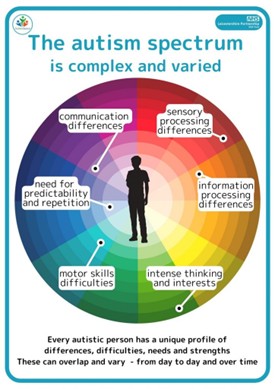
Leicestershire Partnership NHS, Autism Space
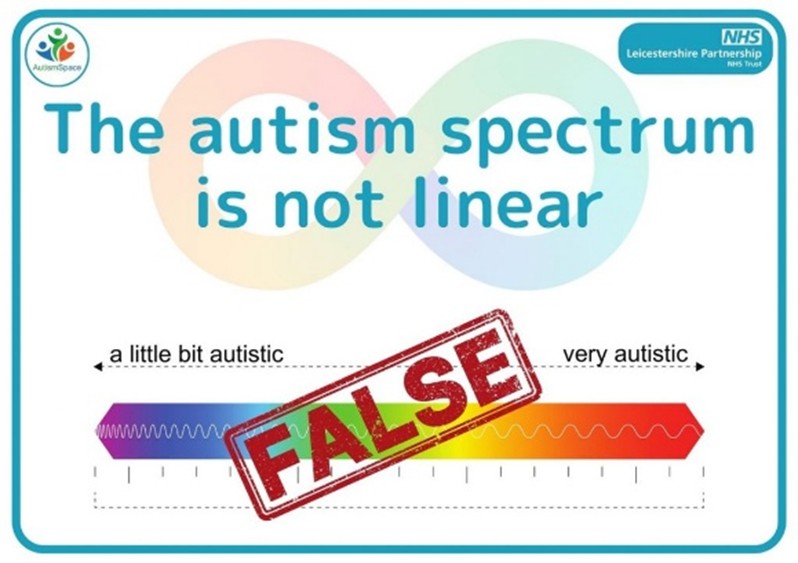
Leicestershire Partnership NHS, Autism Space
Masking
“Masking: When neurodivergent individuals have to hide their actions or characteristics in order to appear neurotypical.” (TheInformedSLP, 2022). This is either taught or learned independently and often includes suppressing stimming, forcing eye contact, using social scripts, because this is what feels “expected” by neurotypical communication partners. However, many autistic individuals have stated that masking is harmful and contributes to poor mental health (TheInformedSLP, 2022).
Why might someone mask? There are many possible reasons, including: to attempt to achieve a perceived sense of safety and acceptance, or avoid potential judgement about their communication differences from neurotypical communication partners. In addition, many environments are designed for neurotypical people, requiring autistic individuals to mask in order to “fit in” in those contexts.
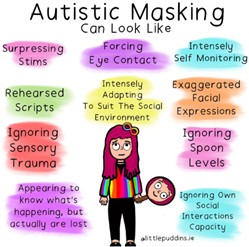
(Amanda Mc Guinness @littlepuddins.ie, 2022)
(The Informed SLP, 2021).
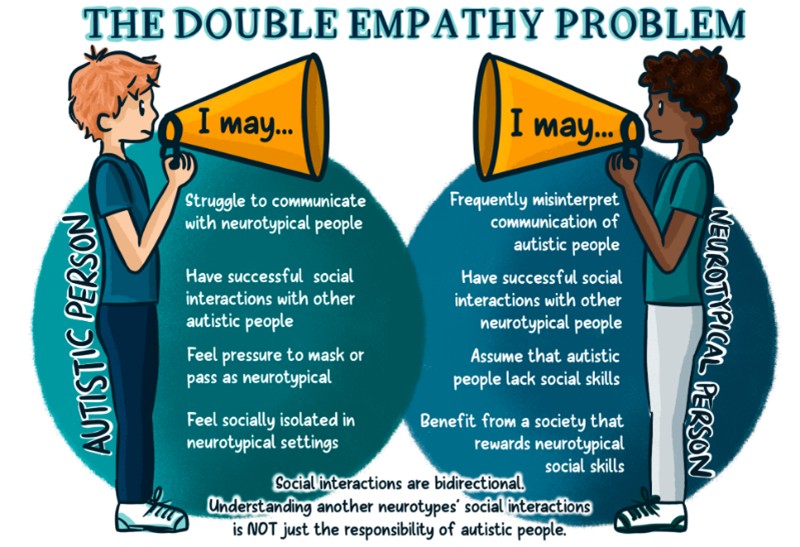
The Double Empathy Problem
Social interactions are bidirectional. It takes two to tango!
This is the idea that both neurotypical and autistic individuals have equally valid ways of communicating, which are frequently successful with others of the same neurotype (i.e., autistic person with autistic person; neurotypical person with neurotypical person). However, problems can occur when a neurotypical person and autistic person attempt to communicate with each other but have differing communication styles that are not equally understood or valued. This often results in a communication breakdown, leading to misunderstandings. Often, the autistic individual gets the blame for “poor communication”, despite communication being a two-way street.
ACCEPTANCE
Now that you’re aware of what Autism is (remember, this is just at surface level and a very general, brief description), it’s time to discuss ways to move towards acceptance. Because you can’t have acceptance without awareness!
Autism Acceptance celebrates autistic strengths, It is crucial for advocacy and change to listen to autistic voices, in all communication forms and across the entire spectrum and of different backgrounds and experiences (e.g., BIPOC, high and low support needs, 2SLGBTQIA+, self-diagnosed, non-speaking, co-occuring diagnoses) (@the_optimisticot).
The next steps in Autism Acceptance include (adapted from @the_optimisticot):
- Inclusive environments within the community including schools and workplaces.
- This might look like having flexible seating and sensory tools available, allowing for movement breaks throughout the day, and providing regulation spaces.
- It is important to have unrestricted access to accommodations and support strategies to foster an equitable environment and allow neurodivergent individuals to flourish with their full potential.
- Education and training for teachers and therapists who work with the autistic population.
- Connection and compassion over compliance.
- This means focusing on forming meaningful relationships, seeing behaviour as a potential form of communication, and providing support through co-regulation.
- Celebrating authenticity
- All play is okay (as long as it’s safe).
- All forms of communication are equally valuable.
- Accept and honour social differences (and recognize the “double empathy” problem).
- Incorporate interests into education and therapies.
- Celebrate strengths.
- Respect stimming (as long as it’s safe) – hand flapping, spinning, rocking, etc.
- Respect sensory differences and allow for tools and accommodations.
- Teach, support, and respect self-advocacy and .
To summarize, awareness is not enough! Let’s work towards acceptance, inclusion, advocacy, understanding, support, celebration. (@the_optimisticot).
Interested in Learning More? Check out these Resources!
About Autism:
- 10 facts about Autism
- What Autism is NOT
- Celebrate the Spectrum! Tie Dye Together Events
- https://www.leicspart.nhs.uk/autism-space/all-about-autism/what-is-autism/
Books for kids for growing autism acceptance:
- A Day with No Words by Tiffany Hammond
- Do You Want to Play? Making Friends with an Autistic Kid by Daniel Sharestrom
- A Kids Book About Autism by Justin P Flood
- Flap Your Hands – A celebration of stimming by Steve Asbell
- The way we play: a celebration of Neurodivergent Play Styles by Windy Brzezinska
- Nick and the Brick Builder Challenge (chapter book by Jen Malia
Check out these neurodiversity-affirming professionals & resources!
- @mrsspeechiep
- @play.spark
- @the_
- @littlepuddins.ie
References
- The Informed SLP
- How and why to be a neurodiversity-friendly SLP (February, 2021) https://www.theinformedslp.com/review/how-and-why-to-be-a-neurodiversity-friendly-slp
- Masking to Survive (July, 2022) https://www.theinformedslp.com/review/masking-to-survive
- @play.
- Instagram Post: Autism awareness + Autism acceptance (April, 2025).
- @the_optimisticot (Martha Ní Fhlatharta)
- Instagram Post: This Autism Acceptance Month, here’s what we want to see… (April, 2025).
- @mrsspeechiep (Andi Putt)
- Instagram Post: Understanding Autism (December, 2025).
- Instagram Post: Why Autistic Kids are Often Labeled, “Know-it-Alls” (January, 2026).
- Instagram Post: What is Autism? (December, 2025).
- @littlepuddins.ie (Amanda Mc Guinness)
- Instagram Image: Autistic Masking Can Look Like (July, 2022).
- Instagram Post: Autistic Strengths (March, 2023).
- Leicestershire Partnership NHS: Autism Space – What is Autism?
- Image: The Autism Spectrum is not linear.
- Image: The Autism Spectrum is complex and varied.
- https://www.leicspart.nhs.uk/autism-space/all-about-autism/what-is-autism/